

Check out our Socials


Written by

Marou H.
You have a powerful idea. You know it creates value. You've run the numbers, you believe in the opportunity, and you're ready to move. But without a structured, persuasive business case, even the most brilliant initiatives get shelved, underfunded, or endlessly delayed.
The hard truth is that decision-makers don't just evaluate ideas, they evaluate how those ideas are presented. A business case is not a document. It's a strategic argument, a logical journey that takes your audience from "here is the problem" to "here is the solution" to "here is why you must act now."
In this guide, we break down every section of a winning business case, what each one needs to achieve, and how to write it in a way that makes approval feel like the only logical outcome.
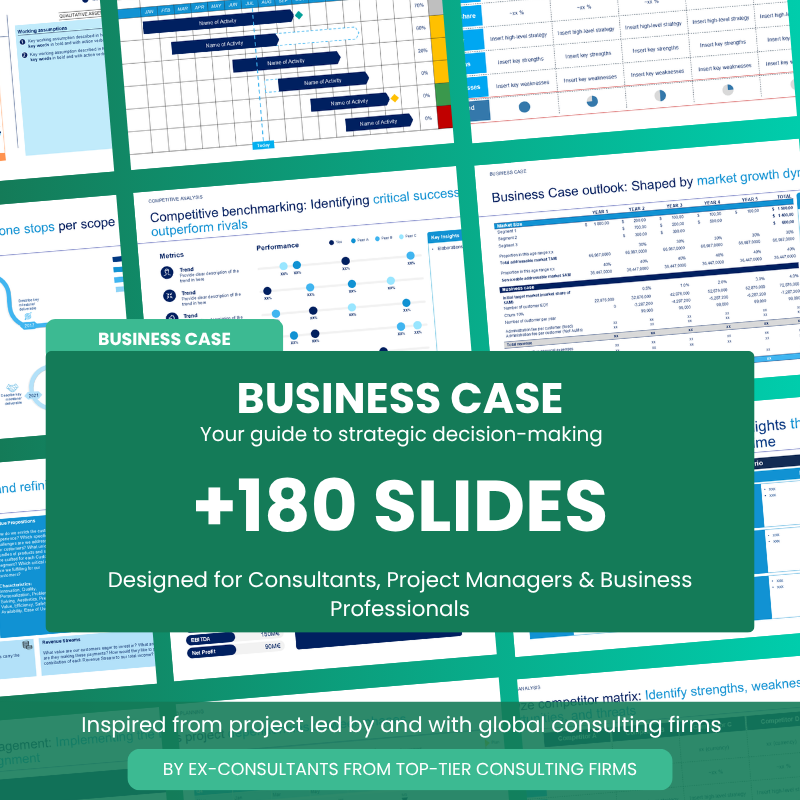
Business Case Templates
Your business case doesn't just need to be right. It needs to be convincing. It needs to move decision-makers. It needs to turn a great idea into a funded, approved, actionable initiative. That's exactly what this toolkit is built to do.
Get the templates now
Step 1:Write a Killer Executive Summary
Your executive summary is the most important section of your entire business case — and it's the one most people write last and rush the most. This is a mistake that costs approvals.
Decision-makers are busy. Many will read only this section before forming their opinion. Your executive summary must communicate the problem, your key findings, your recommendation, and the expected impact — all in one scannable page.
State the core problem or opportunity clearly in 2 sentences
Summarize your 3 most compelling findings
Lead with your recommendation — don't bury it at the end
Include the expected ROI or impact upfront
Step 2: Define Your Point of Departure
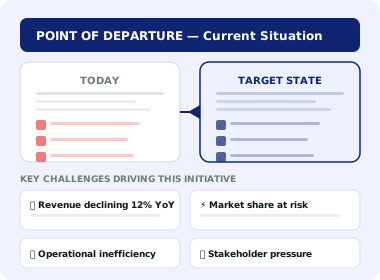
Before you can propose a solution, you need to establish the current reality in a way that makes your audience feel the urgency. Your point of departure answers one fundamental question : "Why does this initiative need to happen and why now?"
This section paints a clear picture of the current state, the pain points it creates, and the cost of doing nothing. It sets the emotional and rational foundation for everything that follows.
Describe the current situation with specific data, not vague statements
Quantify the cost of inaction: revenue lost, time wasted, risk exposure
Show the gap between where you are today and where you need to be
Make the problem feel urgent without being alarmist
Step 3: Map Your Market & Customer Segments
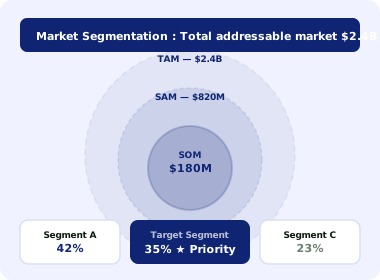
Decision-makers need to understand the opportunity size before they'll commit resources to capture it. Your market and customer segmentation section answers the question : "How big is this, and who exactly are we going after?"
This is where you prove that the opportunity is real, it is sizeable, and you have a clear view of which customers you're targeting and why they're the right priority.
Quantify the Total Addressable Market (TAM), SAM, and SOM
Segment the market by the most relevant dimensions for your business
Identify your priority segment and explain why it's the right focus
Include competitor positioning to show white space opportunities
Step 4: Build Your Financial Projections
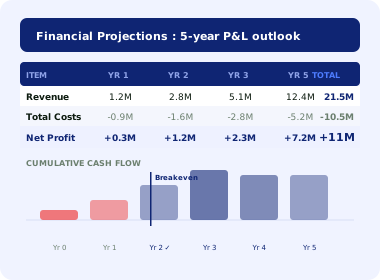
This is the section that most directly determines whether your business case gets approved or rejected. Numbers create credibility but only when they are structured clearly, grounded in assumptions, and tell a coherent financial story.
Your financial projections must show decision-makers not just what the returns look like, but when they can expect to see them and what assumptions drive each number.
Include a 3 to 5 year P&L projection with revenue, costs, and net profit
Show the breakeven point clearly — when does this initiative pay for itself?
Present ROI, NPV, and payback period as headline metrics
Document your key assumptions so decision-makers can stress-test them
Include a sensitivity analysis showing best, base, and worst case scenarios
Step 5: Address Risk Head-On
One of the most common business case mistakes is glossing over risks or burying them in an appendix. Experienced decision-makers will always ask "what could go wrong?" and if you haven't answered it proactively, you've lost credibility.
A strong risk management section doesn't weaken your business case. It strengthens it by showing that you've thought rigorously about every angle and have a plan for what to do if things don't go as expected.
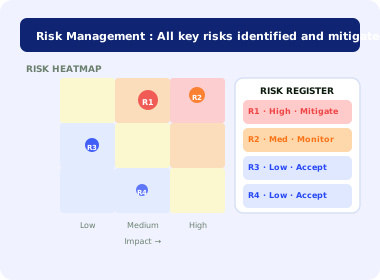
Identify your top 5 to 8 risks across strategic, financial, and operational dimensions
Rate each risk by probability and impact — use a visual heatmap
Provide a clear mitigation strategy for every high-priority risk
Show which risks you will monitor, mitigate, accept, or transfer
Step 6: Close with a Clear Recommendation
Every section of your business case has been building toward this moment. Your recommendation slide is where you convert all of your analysis into a single, unambiguous call to action. It answers the only question that truly matters : "What exactly do you want us to do?"
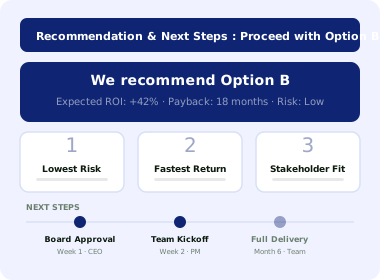
State your recommendation directly and confidently. Provide your 2 to 3 strongest supporting reasons. Then present a concrete, time-bound set of next steps that show you're already thinking about delivery.
State the recommendation in one clear sentence — no ambiguity
Present 2 to 3 specific reasons this is the right path forward
Include next steps with named owners and clear deadlines
End with the decision you are asking the audience to make today
A great business case is never just about having the right idea. It is about presenting that idea in a way that makes approval feel like the only logical outcome. The structure you have just worked through,from a compelling executive summary to a rigorous financial projection, a clear risk assessment, and a direct recommendation is exactly the framework that top consultants use to turn great ideas into funded, approved, actionable initiatives. Every section exists for a reason. Every slide serves the argument. Nothing is there by accident.
The decision-makers sitting across the table from you are not evaluating your idea in isolation. They are evaluating your thinking, your rigor, and your credibility. A well-structured business case answers every question before it is asked, removes every reason to hesitate, and leaves your audience with one clear path forward : yes. You now have the blueprint. The question is simply how fast you can put it to work.
Start with the problem. Build the case. Close with conviction.
And if you want to skip the blank slide entirely Business Case toolkit gives you 180+ fully editable, consulting-grade slides covering every section in this guide, built by ex-consultants who have used them in real boardrooms at the world's top firms. Your next approval is closer than you think
Business Case Templates
Your business case doesn't just need to be right. It needs to be convincing. It needs to move decision-makers. It needs to turn a great idea into a funded, approved, actionable initiative. That's exactly what this toolkit is built to do.
Get the templates now
Deliver presentations that impress
Stop wasting hours on design. Get instant access to our premium ready-made templates and start creating impactful, professional slides in minutes.
Get instant access now !


